
We don’t price the fund. We make it priceable.
Kruncher turns a fund data room into a reviewed, source-linked workbook in your template, with every holding analyzed and current to the day you bid. Your team stays; your reviewers check only what is flagged.
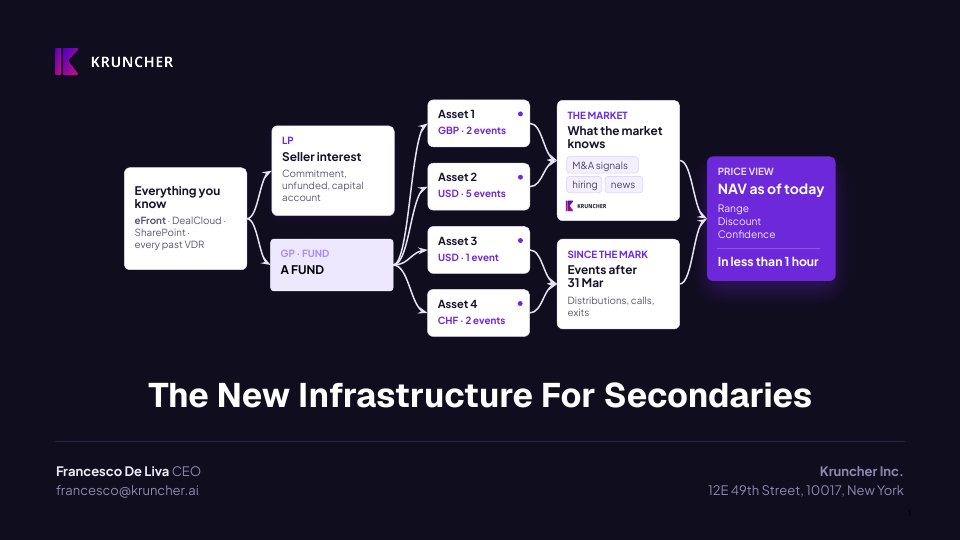
From data room to price, with everything known today
The best bid draws on three sources at once, and is ready before the deadline.
- The data room.
Capital accounts, quarterly reports, schedules of investments, side letters and the LPA when it is shared.
- What your firm already knows.
Past deals with the same GP, notes and models in eFront, DealCloud and SharePoint. It stays yours, segregated, never shared or used for training.
- What the world knows today.
Hiring, leadership, news and comparables for every company, since the last mark.
- Day 0Data room opens
- Day 1Model ready
- Day 5Bid due
Up to 50 million data points and signals a quarter for a large secondaries buyer*
*Top of range: 100 projects × 5 to 10 funds × 10 to 30 companies × 1,000+ data points and 600+ signals, plus ~3,000 fund-level data points per fund.
Every option today gives up speed, accuracy or cost
And all of them stop at the data room: about 80% of the companies in a fund are not analyzed in depth.
- Manual or outsourcedAnalysts, Excel or an offshore team
- Speed
- Weak: 3 to 5 days per fund
- Accuracy
- Strong: High
- Coverage
- Weak: Top 3 to 5 holdings, about 20%
- Capabilities
- Mixed: What the analyst remembers
- Cost to run
- Weak: Analyst or vendor days on every fund
- Existing productsDocument AI vendors
- Speed
- Strong: Hours
- Accuracy
- Weak: Not accurate enough on fund data
- Coverage
- Mixed: The documents, not the companies
- Capabilities
- Weak: Limited: fixed schema, no fund structure
- Cost to run
- Mixed: License, plus the rework
- In-house AI buildYour own team and stack
- Speed
- Mixed: Fast, after months of building
- Accuracy
- Mixed: Only as good as the team behind it
- Coverage
- Mixed: Whatever the team has time to build
- Capabilities
- Mixed: Grows only with headcount
- Cost to run
- Weak: A full team, infrastructure to scale, ongoing maintenance
“We tried AI, but every figure needs a second look because nobody knows which ones are wrong. The correction eats the benefit.”
Fund data is a structure problem, not a text problem
Generic AI reads one page at a time. Fund data breaks across documents, vehicles and quarters.
The same fair value, counted twice.
Funds, feeders, parallel funds and AIVs report at different levels. Sum a combined statement on top of the vehicle schedules and the same asset is counted twice.
Kruncher resolves the fund structure first.
Name changes across quarters.
GPs rename assets, restructure vehicles and switch reporting currency. Read naively, a rename is a write-off plus a new deal, and cost basis and holding period vanish.
Kruncher reconciles every rename, decided once.
The NAV you are shown may not be the NAV you buy.
Many managers present the capital account gross of accrued carry. It is GAAP compliant, and it makes the position look bigger than what is actually being bought.
Kruncher extracts the basis and carries accrued carry as its own position.
The reference date gap.
Nothing in the data room says what happened to the companies after the reference date. That is exactly the window in which the price moves.
Kruncher tracks every company since the mark.
From a data room to a mark you can challenge
The fund family, resolved before a single figure is extracted
Master, feeders, parallel funds, AIVs and the seller’s position inside them are resolved from the fund documents first (the LPA when it is in the data room) and land in the same knowledge graph Kruncher draws for every entity. Sleeve values are scaled by derived ownership and never summed twice.
Look-through stake: 2.1% × 34.0% = 0.71% of the master, applied once to each holding. Never summed again at the parallel or the AIV.
Every figure traceable to its page
Each value carries its source file, page and coordinates, with competing candidates and the reason one was preferred. Behind every value sit hundreds of configurable definitions and validations, with a NAV check built in: the fund rebuilt from the top down and from the bottom up. Deterministic checks run on every cell: PASS is silent, WARN and FAIL surface with the numbers behind them.
- Beginning balance
- 1,318,402
- Contributions
- 412,000
- Distributions
- (598,113)
- Ending capital balance
- 1,246,629
- 1,281 sourced to a page
- 13 missing, left blank
- 28 flagged for review
Hundreds of funds in parallel, straight into your systems
Under 45 minutes per fund, data room to workbook, whether you run one fund or hundreds in parallel; the look-through on every holding adds time. Delivered in your Excel template, by API and webhook, into Snowflake, or through MCP in Claude or ChatGPT.
- Fund 01<45 min
- Fund 02<45 min
- Fund 03<45 min
- Fund 04<45 min
- …same
One fund or hundreds: the time per fund does not change.
 ExcelIn your template
- API and webhookOn completion
- SnowflakeInto your account

 MCPClaude or ChatGPT
See every company, not just the top five
Other bidders price the holdings they had time to read. You price the whole fund, current to the day you bid.
Typical bidder.
5 of 20holdings reviewed, priced off a GP mark up to two quarters old.
With Kruncher.
20 of 20holdings reviewed, current to the bid date.
Stale GP marks flagged
1,000+ data points and 600+ signals on every company in the fund, every quarter.
The result: a better-informed price. You know which marks are stale before you set the discount, on the companies other bidders never read.
Every fund you see becomes your own data
From scattered documents and spreadsheets to one standardized data model that compounds with every deal.
- Capital account
- LPA
- Q2 report
- fund_model.xlsx
- Side letter
- eFront export
- Email thread
- notes_v3.xlsx
- SOI.pdf
One data model for every project, fund, vehicle and company, in your definitions.
Every fund you have seen or invested in, bid or not, adds to the same record.
Compare a new fund with everything you have seen: marks, terms, managers, companies.
Yours: in your Kruncher workspace or inside your own cloud, never shared with another client, never used for training.
See how the data layer is builtKruncher for Secondaries, in four minutes
Four minutes on why it matters, then the product itself: a live walkthrough and a completed fund workspace to explore.
A completed fund workspace on a synthetic fund: the overview, the workbook, the structure, the portfolio analysis, the checks and the delivery.
Uncertainty is shown, never hidden
- Every figure is extracted, derived, missing or flagged, never filled by assumption
- PASS is silent; WARN and FAIL surface with the numbers behind them
- Corrections stay in your workspace and improve the next fund from the same manager
- 85 to 90% accuracy on the first run against your template; 95%+ after two or three workshops on your definitions
- Your team stays: Kruncher is the maker, your reviewer is the checker
- Excel in your template, JSON, the API with webhooks, or MCP
- SaaS, or deployed in your own AWS, Azure or GCP with your approved models
- Your cash flow model and underwriting stay yours: build your edge in the projection, not in the ingestion
- ISO 27001, SOC 2 Type II and GDPR
- Isolated tenant; your data never trains shared models
- Full export, whenever you want it
- 01Classify
- 02Resolve structure
- 03Extract
- 04Derive
- 05Validate
- 06Review
Built by data scientists and secondaries practitioners
Already working for 40+ investment funds on three continents.
Data science and NLP
- Document ingestion for banks and investors since 2016.
- Knowledge graphs that resolve funds, vehicles and companies.
- Validation that shows your reviewer where to look.
Finance and secondaries
- Financial analysts review the output every day.
- Senior secondaries practitioners define the checks: structure, carry, timing, marks.
- Your taxonomy and definitions, set in three iterations.
The best model for every task
- Frontier models from our technology partners, each used where it measurably does better.
- Our own open-weight models for document extraction.
- Every task benchmarked and re-tested as models evolve, balancing cost and performance.
 AnthropicPartner

- NVIDIAPartner
 for Startups · Member
 SuperReturn 2026
 Data-Driven VC Report 2026
Take the teaser to your investment committee.
The download starts when you send the form.
The problem, where Kruncher sits, accuracy, the information advantage, your data layer and the team.
Benchmark us on a fund you have already priced.
Send us one fund you have already priced. Within a day you receive the workbook, the JSON and the validation report, to mark against your own analysts’ work.