
Knowledge Infrastructure · How it works
You cannot prompt your way out of fragmented data.
The reason the modules can be trusted: one resolved, current, thesis-aware view of every company, person, and fund your firm touches.
Workflows & Automation
ORCHESTRATION
Origination
Sourcing & screening
Diligence
Analysis & scoring
Portfolio
Monitoring & KPIs
Analytics & Intelligence
FUND
Pipeline · companies tracked
Inbox
965
Screening
212
Due diligence
48
Portfolio
15
Your Agents & Apps
AGENTS · SDK
Cowork agents
Run tasks with agents
MCP server & SDKs
Claude · OpenAI · Gemini
Build your app
Integrate via Kruncher APIs
Kruncher’s Knowledge Graph · sample view
+ 1,384 more companies and + 633 more people not shown
22 / 2040entities
31 / 4,200relations
479signals tracked
1,520,000data points
Sources
INGEST
CRM · Email · Drive & data rooms · Call transcripts · Messaging · Web research · Data providers
Your diligence playbook
THESIS
Deal score · Thesis · Fund · Signals
Your decisions
EXECUTION
Generate memo · Warm intro · Schedule · Peer review
One knowledge graph: companies, people, and funds resolved into a single connected record.
The problem
Six reasons raw data breaks AI
Foundation models solved reasoning. They did not solve the data. Six structural problems sit underneath almost every wrong answer.
Fragmented
One company shows up as five scattered versions across your tools.
Inconsistent
Sources disagree, and AI cannot tell which one should govern.
Incomplete
AI fills gaps by generalizing from public patterns, and passes guesses off as facts.
Changes over time
AI repeats an old number as if it were current, with no sense of history.
Needs standardization
Analysis needs a taxonomy and a peer set that is never actually defined.
Your view is missing
AI applies a generic lens, not your firm’s thesis and judgment.
Keynote · SuperReturn
Same Brain, Different Memory: Why your data, not your model, is the tech moat from here on.
Presented by Francesco De Liva, CEO at Kruncher
From fragmented inputs to a record you can trust
Built bottom-up, the way the product does: from unstructured inputs to a resolved, standardized record with your judgment on top.
Fragmented → Unified
One company, not five scattered versions
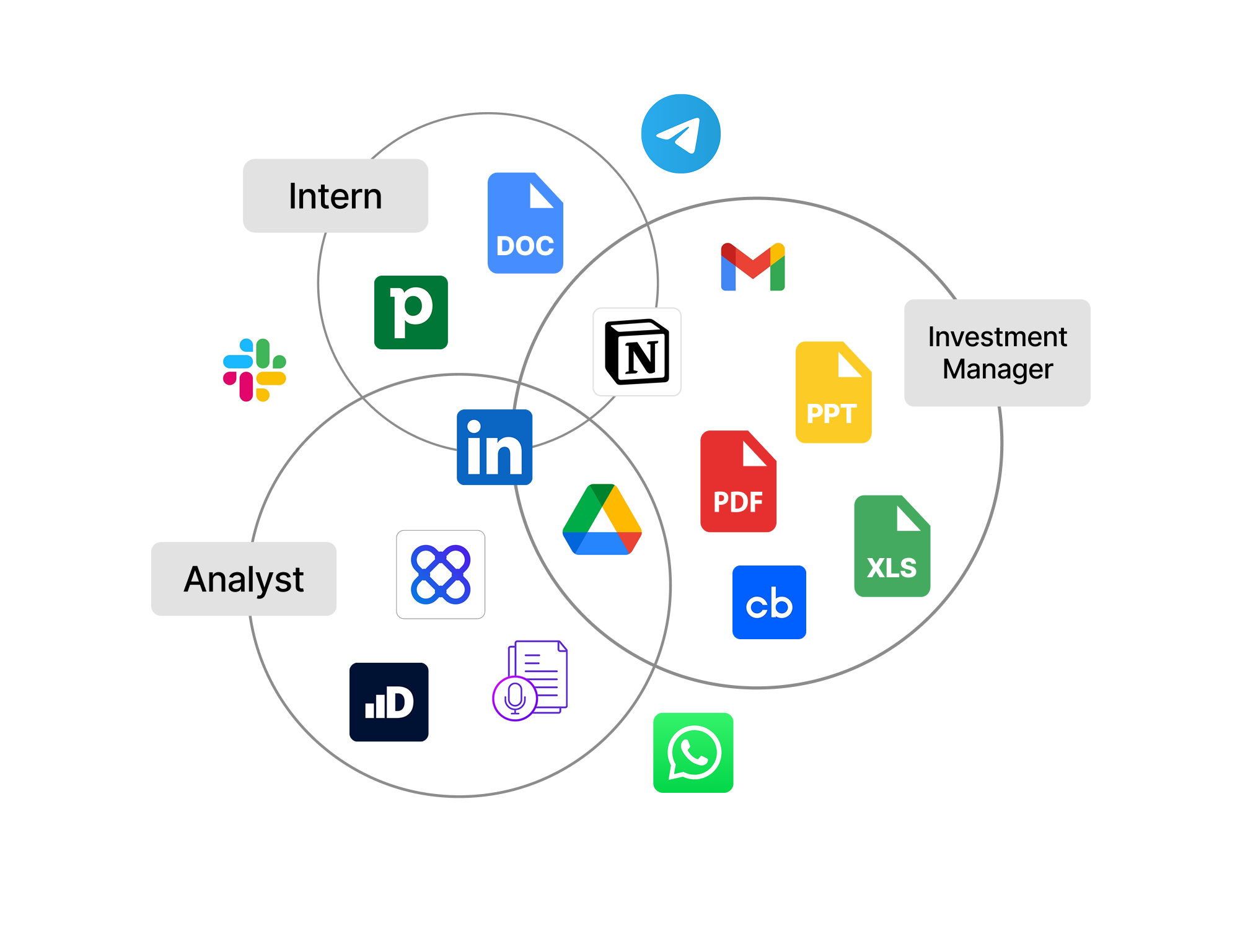
Every role in the firm captures data somewhere different. Kruncher ingests all of it, from CRM, documents, transcripts, email, messaging, LinkedIn and your address book, plus 20-plus premium sources, in any language, and resolves it into one clean record linked in a knowledge graph of companies, people, and funds.
A continuously running engine
Raw data and documents in, IC-ready reports out
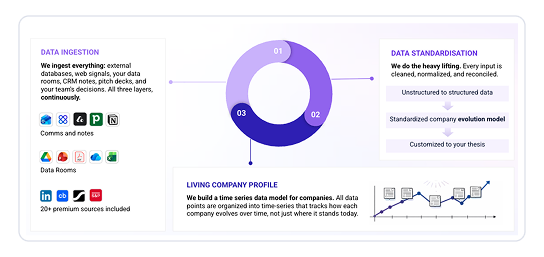
Kruncher ingests everything, standardizes it, and keeps a living profile of every company, continuously. The same pipeline runs behind screening, diligence, and monitoring, so every module reads from the same current record.
- Ingest all three layers: external data, your data rooms, your team’s decisions
- Standardize: unstructured to structured, reconciled and normalized
- A living profile: a time-series model, not a one-off snapshot
Under the hood
The 14-step ingestion process
Every document and data feed passes through the same pipeline before it becomes a data point you can trust.
01
Connect your sources
02
Ingest documents & feeds
03
Parse PDFs, decks & Excel
04
OCR & text extraction
05
Detect language & translate
06
Extract entities
07
Resolve entities
08
De-duplicate records
09
Apply source precedence
10
Normalize fields
11
Standardize taxonomy
12
Enrich from 20+ sources
13
Build the knowledge graph
14
Update time-series & score
Global by default
Reads the world in its own language
Kruncher ingests 20-plus premium databases and public registries across the EU and beyond, plus documents in any language. Everything is normalized into structured English, with a link back to the original-language source, so your coverage never stops at the border.
- Multilingual ingestion, normalized to English
- EU and global public-registry coverage
- The original-language source is always linked
Sources & registries
CrunchbasePitchBookCompanies House (UK)Cerved (IT)Bundesanzeiger (DE)LinkedInStatistaSemrush+ your CRM & documents
01Fragmented
Unified Company Record
Ingest everything and resolve it into one clean record, linked in a knowledge graph of companies, people, and funds.
02Inconsistent
Source Precedence
When sources disagree, the latest and most authoritative one governs. Contradictions are resolved, not averaged.
03Incomplete
Layered Record & Gap Detection
Labels each value by type (core data, premium, Kruncher estimate, your notes) and flags missing data instead of filling it. You always know a fact from an estimate.
04Changes over time
Living Company Profile
A time-series model and the Time Machine: a full change history where every change carries its source and date. No stale number repeated as current.
05Needs standardization
Standardization
Unstructured to structured: roughly 1,000 normalized data points per company, with consistent peer sets so companies are actually comparable.
06Your view is missing
Your Lens (Adaptive Learning)
Thesis, deal score, and preference learning sit on top. A thumbs-up teaches the system what your firm values, so later analysis reflects how you decide, never from shared-model training.
Specialists on the job
Deck readerTranscript analystFinancialsMarket sizingCompetitor scanTeam & foundersTraction signalsRisk flags
Not one model, many specialists
30+ specialized agents, working in parallel
Kruncher is not a single prompt. Dozens of specialized agents each read one slice, decks, transcripts, filings, competitor sites, and extract traction, unit economics, team and category signals, then hand off to the next. Purpose-built for private markets, not a generic LLM wrapper.
Layered record · Your lens on top
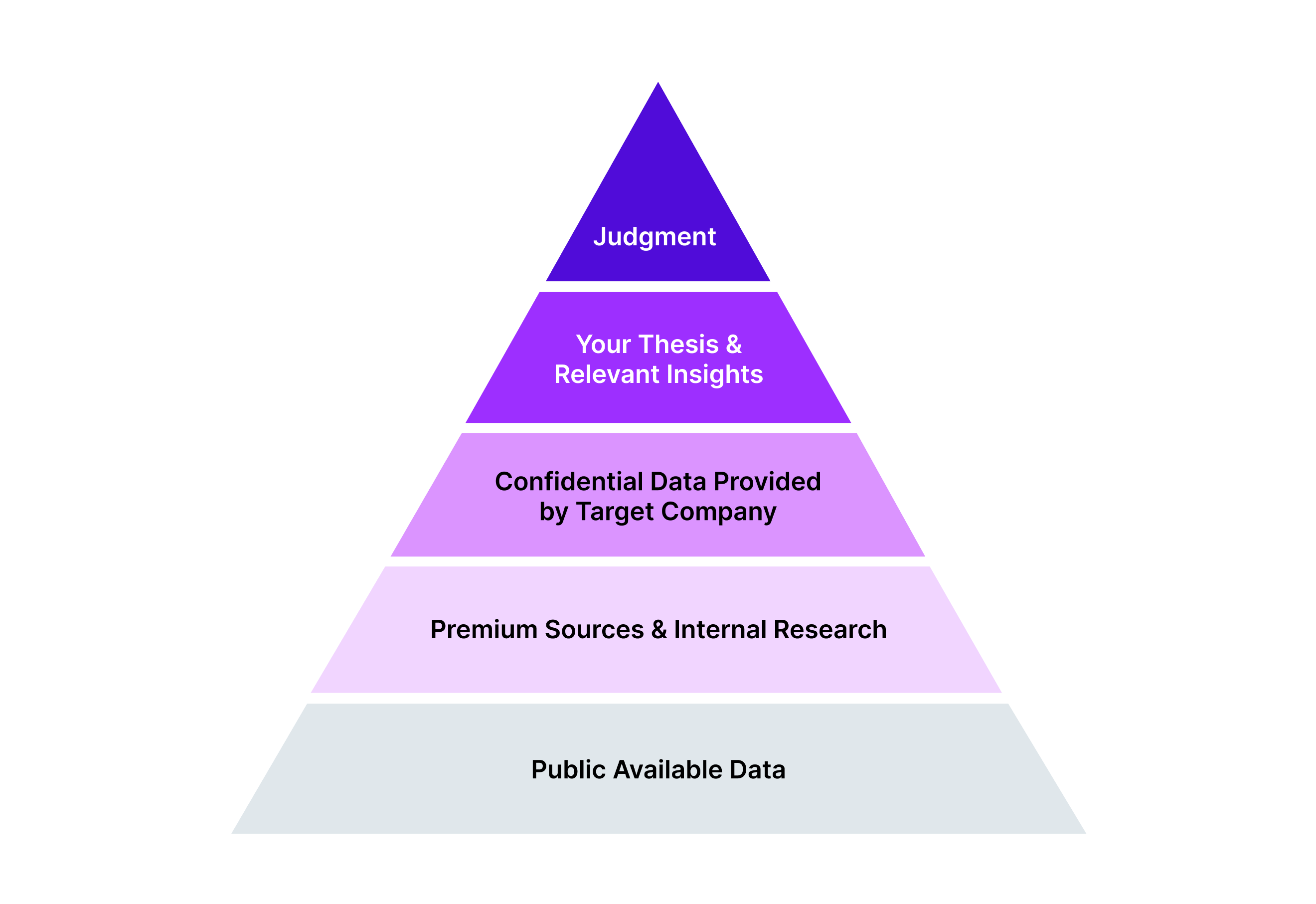
Public data at the base, your judgment at the peak
Every analysis is built in layers. Public data forms the foundation, premium sources and your internal research sit above it, confidential data from the target company adds depth, your thesis focuses it, and your judgment sits on top. Each value is labelled by which layer it came from, so nothing is a guess dressed as a fact.
Company analysis
Every company, fully analyzed
One standardized report, built the same way every time so companies are comparable.
MarketTeamCompetitive landscapeBusiness modelTractionFinancialsRisks
Your investment criteria
Scored the way your firm decides
Kruncher applies your thesis and 600 configurable signals, plus any you add, then returns a clear fit.
Match, Deal Score 89/100 No match
A living company profile
Track how a company changes over time
Every data point is stored as a time series, not overwritten. You see how a company evolves quarter over quarter, when each number changed, and what it was before, so you understand trajectory, not just today’s snapshot.
Headcount, revenue, and every metric, tracked over time
Single source of truth
Five categories of data on one record
Kruncher holds far more than public facts. Each category is labelled, so you always know where a value came from.
Your firm’s opinion on the companyMost specific to you
Your firm’s knowledge
Company dataProtected by NDA
Premium data
External news & signalsPublic foundation
From documents to a knowledge graph
Not just data points. Relationships.
Kruncher turns every document into a knowledge graph that tracks companies, people, and investors, and the relationships between them. Those connections are what let it build accurate answers, not guesses assembled from scattered text.
CompetitorInvestmentStrategic buyer
Adaptive learning
A report specific to your firm, not the same one everyone gets
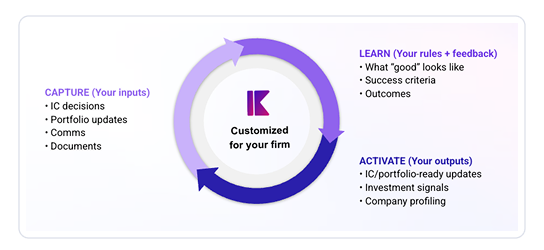
Kruncher learns from your past choices. Every IC decision, portfolio update, and piece of feedback sharpens your scoring, red-flag rules, and deal criteria, so the analysis reflects how your firm actually invests and gets sharper the longer you use it.
Where the advantage lives
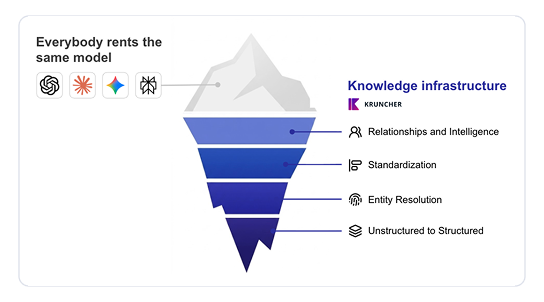
Everybody rents the same model
The model is a commodity. Your edge is the knowledge layer beneath it: unstructured data turned structured, entities resolved, everything standardized, and the relationships and intelligence that only your firm accumulates. That layer is what Kruncher builds and keeps for you.
Your edge compounds
The longer you run on Kruncher, the sharper it gets
Every override, saved view, and diligence note sharpens the proprietary intelligence inside your isolated tenant. Your firm’s pattern recognition, what makes a great founder, what predicts breakout traction, what kills a deal at IC, gets encoded over time. No shared learning across customers; your edge stays yours.
What stays yours
Your data. Your tenant. Your model of the market.
Proprietary interaction data accumulates only for you, never used to train shared models.
Runs underneath everything
No black box
Follow any number in a report back to the document it came from. Here is how one data point gets built, step by step.
The pipeline
A source document arrives
1Extractionpull the raw facts
2Normalizationstandardize the format
3Enrichmentbenchmark vs external data
4Calculationderive the metric
The result, with its evidence
Source [1]
The documents highlight trends such as automation, modular APIs, embedded finance, and bank-fintech partnerships.
Extracted infoDocument1.pdf
Timeframe standardizedKruncher model
External benchmarkingCrunchbase
CAGR calculated using standard formula
Click any number to open its source.
Every data point carries a timestamp and the document, filing, or URL behind it. Every claim opens back to its source.
Trust & Control
Isolated Azure tenant, on-prem option, and full JSON export. Never used to train shared models.
ISO 27001SOC 2 Type IIGDPRAzure isolated tenant
A CRM, built in
Kruncher is also the CRM where you track investors, people, and companies, and the deal flow between them, so your relationships live on the same record as the intelligence.
InvestorsPeopleCompaniesDeal flow
For developers & platforms
The same layer, available as an API
Everything here is accessible programmatically. Call one primitive, analyze a company or document against a thesis, and get structured, sourced, timestamped output. Connect Claude, ChatGPT, or your own agents through the MCP server, or query the knowledge graph directly.
Explore Build on Kruncher →Build on the primitives
Company Enrichment API
People Enrichment API
MCP Server
Knowledge Graph Access
Explore the building blocks
What the engine runs on
20+
Premium data sources
See every database and feed Kruncher pulls from.
View data sources →600
Configurable signals
Browse the full list of signals you can score and alert on, and add your own.
See the signal list →30+
AI agents & skills
Meet the specialized agents that run the analysis in parallel.
Explore AI agents →Reference infrastructure
Deployment architecture
One platform, two deployment options: a dedicated, isolated tenant on Microsoft Azure (default) or on-premises in your own datacenter. Same components, same governance boundary.
Deployment boundary
Kruncher platform
Your systems & models
Your data sources
CRM
Deals, notes, relationships
Email & messaging
Gmail, Outlook, Slack, WhatsApp
Documents & data rooms
Drive, OneDrive, SharePoint
Call transcripts
Granola, Fireflies, Otter, Read
External data providers
20+ premium sources · web research
Kruncher platform · isolated per customer
Azure tenant (default)On-prem option
Connectors
OAuth, read-only, scoped · sync from your sources on their cadence
API Gateway
REST API · MCP server · webhooks · authentication & access control
Ingestion
Classification · dating · type-specific extraction · entity resolution
Enrichment layer
External sources reconciled into a separate, labeled data layer
Analysis
Standardization · estimates · diffs & signals · thesis fit · re-runs on change
Agent layer
30+ specialized agents per analysis run · review queues · feedback loop
Model orchestrator
Any request → any model
Routes each task to the best model by policy: capability, cost, residency
Model pool
OpenAIAnthropicGoogleSpecialized extraction modelsLocal / private models (on-prem)
Models are swappable; the data model and its guarantees never change.
Databases
Time-series facts · versions · source precedence · lineage
Knowledge graph
Companies, people, investors, products — and their relationships
Storage
Source documents, encrypted at rest · every fact links back here
No cross-tenant data flow · customer data never trains models
ISO 27001SOC 2 Type IIGDPR
How you consume it
Kruncher UI
Reports, timelines, signals, Time Machine
Your applications
Company & People APIs · valuation models
Your AI agents
Claude, ChatGPT, custom agents via MCP
Warehouse & CRM
Scheduled sync · CRM write-back enrichment
Alerts
Signals routed to email, Slack, WhatsApp
Azure tenant · default
Dedicated, isolated environment per customer on Microsoft Azure. Kruncher operates the platform; you own the data. Fastest to deploy, continuously updated.
On-premises · option
The same platform deployed in your datacenter or private cloud, for strict residency or regulatory requirements. The model orchestrator can route to local or private models so data never leaves your perimeter.
Whitepaper
How to build your own knowledge infrastructure
Written for the engineer, the data lead, or the head of platform who has been asked to make the firm data-driven and get real value out of AI. It sets out what the layer has to do, in the order it has to be built, so you can decide what to build yourself and what is not worth your team’s years.
- The five layers, in the order they have to be built
- Source precedence and the layered record, worked through
- What to buy versus build, and the adoption framework
Every output is traceable, sourced, and audit-ready
Kruncher outputs are evidence-linked and governed, so your team can trust them and use them consistently. This is the layer every module reads from.
600
configurable signals
20+
premium sources
~1,000
data points / company
30+
AI agents