Same brain, different memory · 20 sections · Francesco De Liva, CEO · August 2026
Knowledge infrastructure
Entities
Intelligence engine
Agents
Workflow automation
Five layers, bottom-up. Each one is only as good as the one beneath it, which is why the order you build them in decides whether any of it works.
20+
Premium sources
~1,000
Points per company
600
Configurable signals
30+
Agents per run
100k+
Companies analysed
40+
Paying funds
Executive summary
The race that is beginning is a data race
Access to intelligence has collapsed as a differentiator. Your competitor rents the same models you do, connects the same tools, and runs the same overnight analysis. Inside a private-market firm, knowledge about any single company is scattered across the CRM, the data room, call transcripts, forwarded spreadsheets, partner notes, and three external databases that disagree with each other. Nothing records which version of a figure should govern a decision.
This was always a problem. Generative AI turned it into an acute one, because a model connected to fragmented sources does not resolve them. It retrieves whatever is most accessible and phrases it fluently. The failure mode is not an obviously wrong answer. It is a plausible, well-structured answer built on an unresolved foundation.
Which lands on a specific desk. Somebody at your firm has been asked to make it data-driven and to get real value out of AI, and that person is usually an engineer, a data lead, or a head of platform with a small team and a long list. This paper is written for them and for the partners who fund the work: it sets out what the layer has to do, in the order it has to be built, so the decision to build it, buy it, or split the two is made with the full shape of the problem visible.
Our own answer is that the hard parts are worth buying. Extraction tuned per document type, entity resolution tested against real messes, a precedence engine, and twenty-plus source contracts are years of undifferentiated work that make no fund better at picking or pricing deals. Kruncher built exactly that layer, and exposes it through APIs, an MCP server, and a warehouse sync, so your engineers spend their time on what is actually yours: your thesis, your models, and your workflow on top.
The argument in one line
The models your firm uses are rented and commoditizing. The resolved, governed, time-series record of every company, person, and fund you touch is a durable asset that compounds. Building that record layer internally is a multi-year programme of undifferentiated data engineering. Kruncher delivers it as infrastructure, inside your own tenant.
01The setup
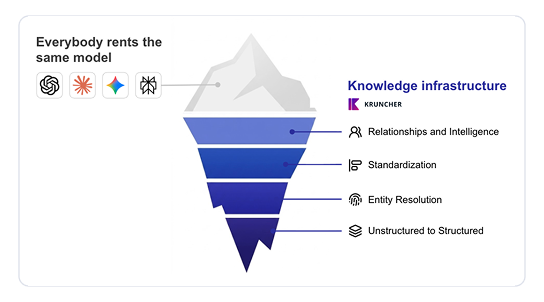
Everybody rents the same model
A fund is not going to out-model the frontier labs. Neither is its competitor. That is the honest starting point, and it is worth saying plainly because most AI conversations inside firms are still organized around the wrong question.
Two years ago, having a model was a position. Today every firm in your comparison set has the same access: the same frontier models, the same connectors into email and drive, the same ability to run analysis overnight that no analyst could staff. Where a capability is universally available at commodity prices, it stops being an edge and becomes table stakes.
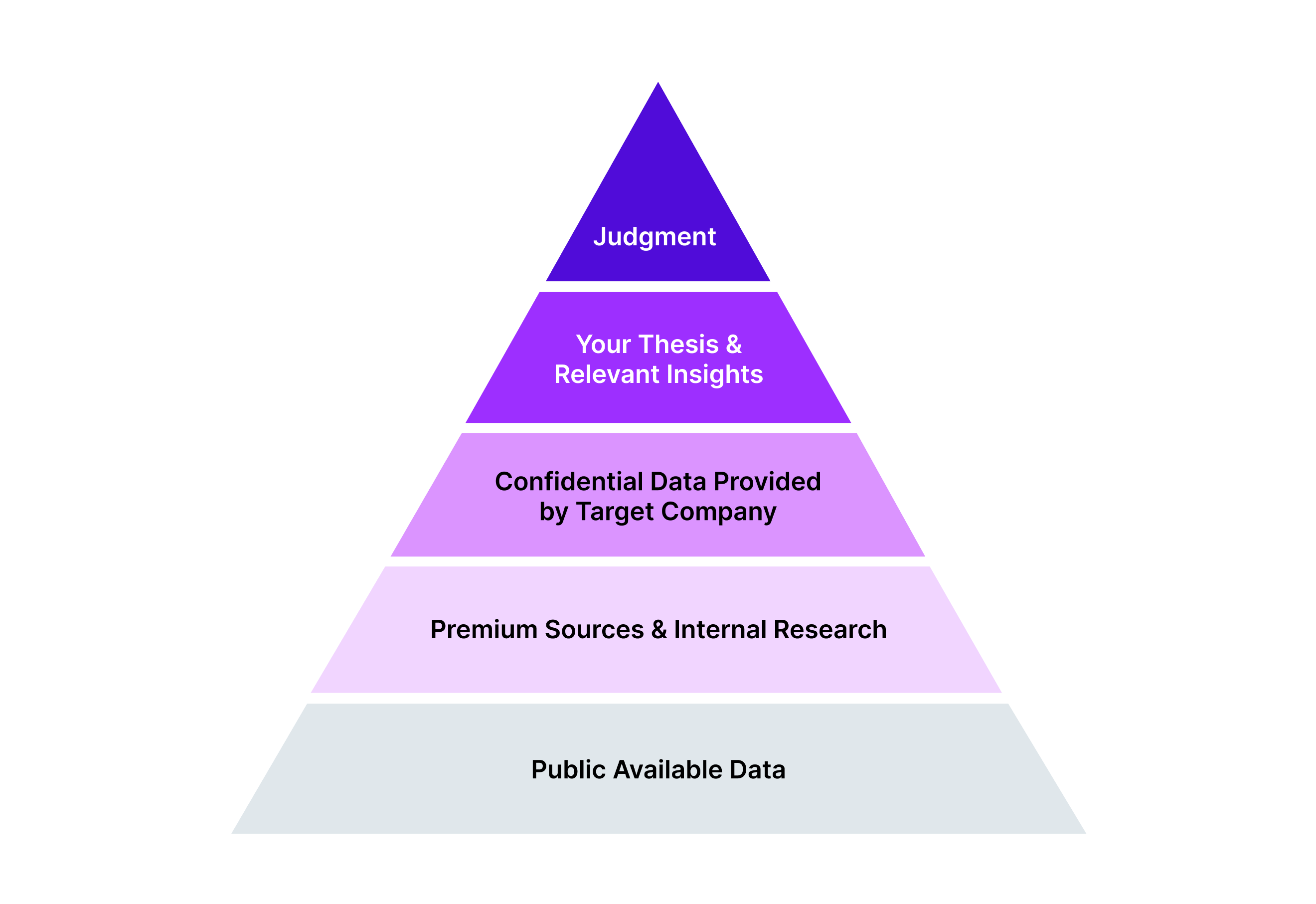
What the model stands on is the firm’s memory: everything it has learned about a company across every touchpoint, in a form something else can read. Two firms running the identical model against the identical company will produce different answers if one of them has a resolved, dated, thesis-aware record and the other has a document store. Same brain. Different memory.
The funds that build a structured proprietary data layer in the next two years will have an edge that compounds. That is the moat, not the model.
SuperReturn Berlin, June 2026 · main stage
02The demonstration
One company, five truths
Pick a company your firm has tracked for two years. Right now it lives in five systems that disagree, and not one person in the firm can see all five at once. Ask an AI assistant for an investment memo on it. The answer comes back in seconds, well-structured, confident, plausible. That is exactly the risk.
Investment memo · ACME
Executive Summary
ACME builds power-flexible data centers for
GPU-intensive AI workloads, positioning it to
benefit from rising compute demand, grid
constraints, and enterprise appetite for
cheaper, flexible capacity.
Early signals look promising: reported growth
of roughly 25%, a building pipeline of enterprise…
Reply…
A model on its own does not
Resolve contradictions
Identify missing data
Apply your investment thesis
Know which source wins
Understand your firm’s history
Every sentence is fluent. Three of them are wrong, and none of them is flagged.
Teaser · Feb 2025+25%Fundraise-era number, never restated
Call notes · Dec 2025~flatNever written up formally
CRM2 recordsCEO duplicated, exit history on one only
Partner notenot foundNo domain in the text, never retrieved
Resolved recordFlat, Q4 2025Management call governs on recency and source authority · prior values retained, visibly outranked · founder resolved to one entity with exit history attached
Access to the documents is not the problem, and it was never the problem. The question is not can the AI see the file. The question is whether the AI knows which fact should govern the decision, and nothing in a retrieval pipeline is designed to answer that.
03The diagnosis
Six structural problems
One memo exposes six problems, and they are structural rather than a single hallucination. Foundation models solved reasoning. They did not solve the data.
Fragmented
One company shows up as five scattered versions across your tools, and no system holds all of them.
Inconsistent
Sources disagree, and nothing in the stack decides which one should govern.
Incomplete
Material data is missing. A model fills the gap by generalizing from public patterns and passes the guess off as a fact.
Changes over time
Which number is the most recent is unresolved, so an old figure gets repeated as current with no sense of history.
Needs standardization
Analysis assumes a consistent taxonomy and a defined peer set. Neither has ever actually been defined.
Your view is missing
The firm's own judgment, meaning how you score a team and what kills a deal at IC, is not in the equation at all.
A seventh property compounds the six: none of it is auditable. When a memo states a figure, tracing it back to a document, a page, and a capture date is manual archaeology, and for a firm defending marks to auditors and LPs, or a European firm reading DORA alongside GDPR, that is a growing liability rather than an inconvenience.
04The mechanism
What a model does not do
The path a standard assistant runs is technically correct at every step and still produces a company view that is not relevant to your fund: interpret the prompt, search connected sources, retrieve snippets, select context, generate an answer.
At no point does that path necessarily resolve whether an entity is represented consistently across sources, whether a newer source should override an older one, whether missing information should be flagged rather than filled, or whether the firm’s own judgment criteria apply. The model is optimized to generate an answer from the most accessible data available, not the most relevant to the investor’s thesis.
Retrieval at question time is also the wrong moment to attempt any of this. Entity resolution, precedence, and time-series placement are expensive operations; running them per question, under a chat latency budget, against whatever happens to be indexed, is not a design that can work. A company’s record has to be resolved before the question is asked, continuously, for every company in scope.
Part Two
The technological layer
Built bottom-up, the way the product is: from unstructured inputs to a resolved, standardized record with your judgment on top. Five layers, one of which, the data model in section 08, is the part that decides whether the other four are worth anything.
05The map
The five layers every investment team needs
Automation is only as good as the reasoning under it, and reasoning is only as good as the knowledge under that. Firms typically buy from the top and discover eighteen months later that the bottom two were never built.
L5
Workflow automation
Where agents, decisions, and human judgment meet: origination, diligence, monitoring, portfolio, M&A, valuation, each a different path through the same four layers below.
L4
Agents
Specialized intelligence working continuously rather than on request: reading, extracting, monitoring, scoring, and escalating what changed.
L3
Intelligence engine
Reasoning built on your knowledge, your taxonomy, and your investment thesis, not a generic lens applied identically to every firm.
L2
Entities
Every company, person, investor, fund, and market connected into one living private-market map, with the relationships between them preserved rather than flattened into text.
L1
Knowledge infrastructure
Connect everything the firm already has, then make it one thing. CRM, documents, transcripts, email, messaging, address book, plus 20-plus premium sources, in any language.
Read this as a diagnostic before reading it as a product description. Most firms have some version of L5, a CRM with workflow, and a partial L1, meaning files exist somewhere, with nothing in between. The gap is L2 and L3, and that gap is precisely why the AI layer disappoints.
06Layer 1
Knowledge infrastructure: connect and ingest
One design principle governs this layer: meet the data where it lives, and change no one's behaviour. A partner who has to remember to upload something will not remember, and a layer that depends on discipline degrades to the discipline available.
Fragmented → Unified
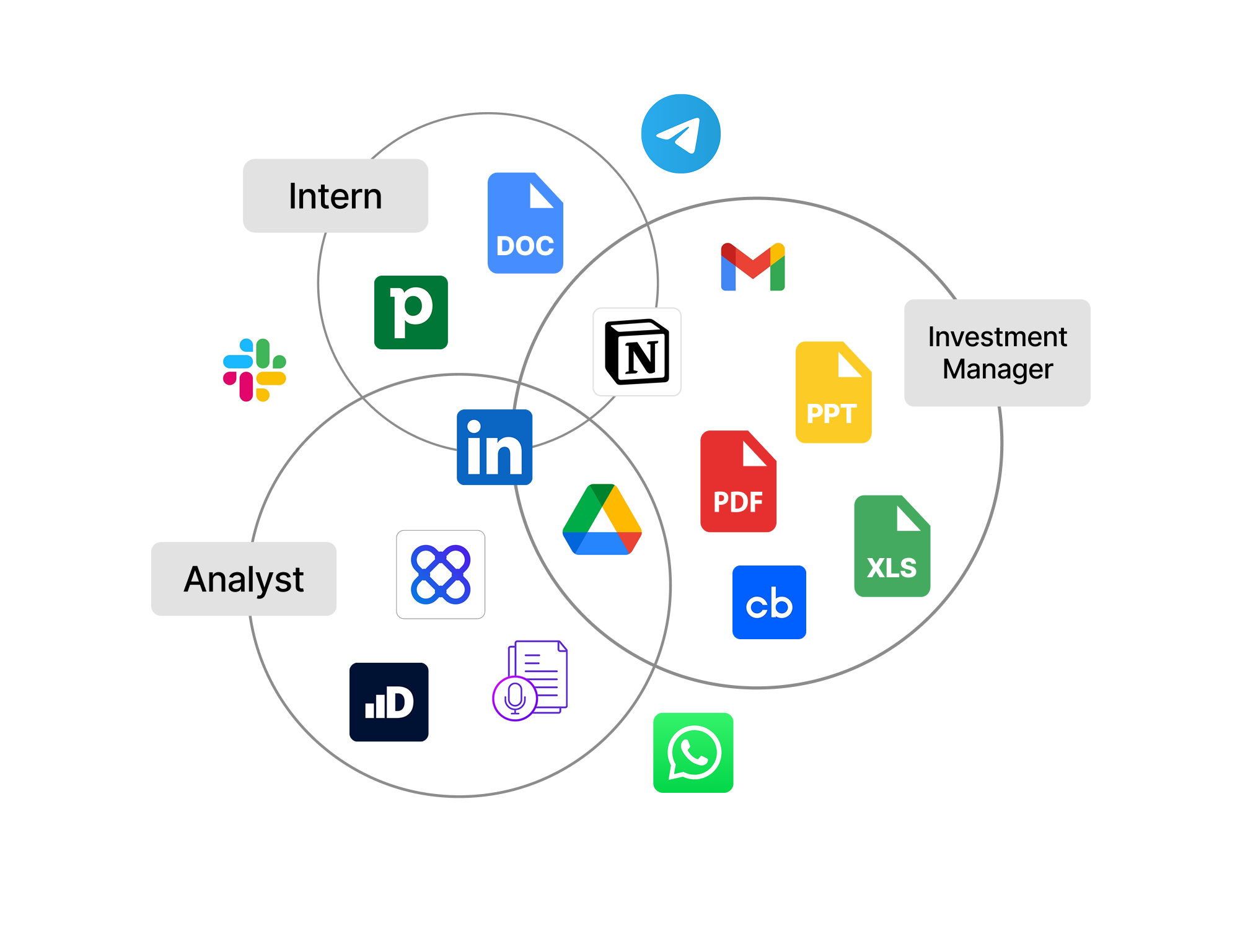
Every role captures knowledge somewhere different
The intern lives in decks and shared documents, the analyst in transcripts and provider tools, the investment manager in email, spreadsheets, and the CRM. The overlap is thin, and the parts that do not overlap are exactly the parts nobody else can see. Connectors are OAuth-based, read-only by default, and scope-limited.
Under the hood
The 14-step ingestion process
Classification comes first, then dating, then routing to type-specific extractors. Facts are dated to the period they describe, not the date the file was uploaded, which is what makes the time series trustworthy and the most common thing an internal build gets wrong.
01
Connect your sources
02
Ingest documents & feeds
03
Parse PDFs, decks & Excel
04
OCR & text extraction
05
Detect language & translate
06
Extract entities
07
Resolve entities
08
De-duplicate records
09
Apply source precedence
10
Normalize fields
11
Standardize taxonomy
12
Enrich from 20+ sources
13
Build the knowledge graph
14
Update time-series & score
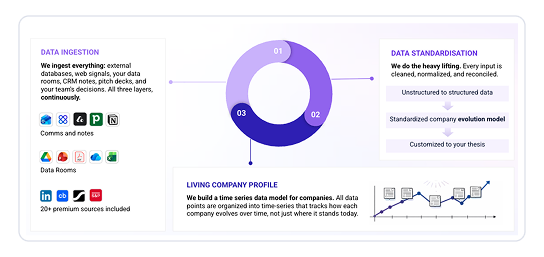
A continuously running engine
Raw data and documents in, IC-ready reports out
Ingest all three layers: external data, your data rooms, your team's decisions
Standardize: unstructured to structured, reconciled and normalized
A living profile: a time-series model, not a one-off snapshot
Multilingual by default, with EU and global registry coverage
07Layer 2
Entities: resolution and the knowledge graph
Entity resolution is the step teams considering an internal build underestimate most reliably, because the failure cases only appear at scale, and by then the record store is already contaminated.
Deterministic keys first
Registered identifiers, domains, provider IDs, and email domains produce high-confidence merges. Where two sources share a key, they resolve immediately.
Probabilistic matching second
Candidate pairs are scored on name similarity, geography, sector, people overlap, and funding history. The system prefers a pending match over a wrong merge, because un-merging contaminated records costs far more.
Splits as well as merges
When evidence shows one record actually covers two businesses, a common artefact of CRM imports and rebrands, the record splits and lineage records which facts belonged to which entity.
The resolved knowledge address book
Connect the front office and the back office so that one person resolves across the CRM, the fund administrator, documents, events, and a partner’s contacts. Click a name and see that they attended the last event, are an LP in fund two, and have now founded a company you are tracking. Duplicates are the failure mode that destroys trust here fastest, so resolving them reliably is a prerequisite rather than a detail.
08The core
The opinionated data model
This is the section that matters most and the one most easily skipped, because it describes a schema rather than a feature. A generic data model can store private-market information. Only an opinionated one can decide what it means.
A general-purpose store, whether a warehouse, a lake, or a vector index, is deliberately agnostic: it will happily hold two EBITDA figures for the same company and the same period without noticing. Something in the system has to know that an audited statement outranks a management deck, that ARR and revenue are not synonyms, that a cap table must sum to approximately 100%, and that a figure from a fundraise teaser deserves less weight than the same figure from a board pack. None of that is inferable from a schema.
The atomic unit
The dated, sourced fact
The unit of storage is not a document and not an embedding. It is a fact: entity, attribute, value, source, and the period the value describes. “EBITDA of €9.2M, from the March board deck, describing Q4 2025” is a fact. “EBITDA = €9.2M” is not storable, because it cannot be compared, superseded, or defended. Roughly a thousand normalized data points are maintained per company, classified against a private-markets taxonomy and then customized to your stage definitions, your sector tree, your bands.
Source precedence
Conflicts are resolved, never averaged
A sophisticated buyer should interrogate precedence rather than accept the claim, so here is the mechanism on a concrete case. Suppose the record for ACME holds four values for EBITDA.
Value
Source
Describes
Category
Status
€7.8M
CIM, Jan 2025
FY 2024
Company data
Historical point
€8.6M
Data-room model, Aug 2025
H1 2025
Company data
Historical point
€8.1M
External provider estimate
2025 (undated)
Premium data
Held, outranked
€9.2M
Management call, Dec 2025
Q4 2025
Company data
Governing value
The precedence engine resolves which value governs, per attribute, using rules the fund configures: recency of the described period, source authority, and category priority. When a partner overrides a fact, the override is written to the opinion category with attribution and governs that firm’s views, while the underlying values remain intact. Nothing is overwritten, so the record can be queried as of any past date, showing exactly what was known at decision time.
Flag, don’t fabricate
Because the taxonomy defines what should exist for a company of a given type and stage, absence becomes detectable. A buyout platform record with no EBITDA margin history is not silent; the gap is a tracked object. Gaps block generations that would otherwise invent, drive collection as management-call questions and data-room requests, and are reported per company and per portfolio as a coverage measure.
09Layer 3
The intelligence engine: your lens
A clean record that scores companies the way everybody else scores them is a database with better hygiene. The sixth structural problem, your view of the world is missing, is the one that decides whether a fund considers the whole system useful or merely tidy.
Computed, not prompted
Thesis fit that an IC can actually interrogate
Your mandate is expressed as a structured lens: up to five hundred weighted parameters evaluated against standardized data points, producing a score that decomposes parameter by parameter into sourced facts. A prompt re-judges from scratch on every run with invisible criteria. A computed lens is deterministic on the same data, versionable, and comparable across weeks and across analysts.
Because every fact sits on a timeline, the system computes what changed between any two points. Those diffs feed 600 configurable signals across people, liquidity, M&A, and business deals, routed to email, Slack, WhatsApp, or Telegram with the evidence attached.
10Layer 4
Agents: specialists, not one prompt
Thirty-plus specialized agents work in parallel, each reading one slice and handing off to the next: deck reader, transcript analyst, financials, market sizing, competitor scan, team and founders, traction, risk flags.
Confidence is first-class
Every extracted fact carries a confidence assessment derived from extraction agreement, document quality, and type-specific validation. A cap table whose ownership does not sum near 100% fails validation regardless of how fluent the extraction looked.
Human review is a workflow, not an apology
Quarantined extractions, ambiguous entity matches, and precedence conflicts surface in a review queue with the source document alongside the proposed value. Every action is attributed and audited.
Corrections propagate
Correcting a fact recomputes derived values, re-evaluates affected signals, and records the correction without erasing history. Point-in-time queries still return what was believed at the time.
Alerts are tuned, not tolerated
Every dismissed signal is a labelled example that tightens thresholds. The operational goal is simple to state and hard to hold: an alert that reaches a partner should be worth the interruption.
11Layer 5
Workflow automation: where the fund meets it
What a deal team sees is six workflows, and each one is a different path through the same four layers underneath, which is why a firm expands inside the platform rather than buying a tool per problem.
Origination
Find and screen companies against your thesis, follow the funds that lead your deals, and reach out with the context you would normally spend a week gathering.
Sourcing agents that track your thesis
Rapid screening built for IC
Outreach and relationship capture
Diligence
Compare companies in minutes instead of days, stress-test the investment case, and produce documents your IC can trace back to the source, line by line.
Configurable checklists with gap tracking
Side-by-side company comparison
Memos and IC decks in your format
Market monitoring & watchlist
Combine what your firm knows with what the market knows, across hundreds of companies, and report without the quarterly scramble.
Continuous monitoring and alerts
Growing versus declining rankings
A live competitive landscape per holding
Portfolio monitoring
Request updates from every holding, combine whatever comes back with what the market already shows, and export in the format the meeting expects.
Live FMV, ARR, and signal alerts
LP reports in your own template
Competitor tracking and add-on targets
Buy-and-build & M&A
Map the full market around each platform, identify targets before they reach a banker, and keep the acquisition pipeline continuously prioritized.
Market and sector mapping
Add-on targets ranked by strategic fit
Growth, ownership, and transaction signals
Secondaries & valuation
Turn fragmented portfolio information into a structured, current view of every underlying asset, with evidence your teams can trace.
Asset-level extraction and standardization
Sourced performance timelines
Structured outputs for your valuation model
Not every firm wants an interface, and the layer does not require one. The same record store is available as a governed data and API layer: REST APIs for company and people records, webhooks for signal routing, an MCP server that connects Claude, ChatGPT, or your own agents directly to the resolved data, and scheduled warehouse sync with CRM write-back.
The whole thing, in one view
The ontology your team would otherwise have to design
Sources feed the ingestion layer; the ingestion layer produces the knowledge graph of companies, people, funds, and the relationships between them; your thesis and your decisions sit on top; and the workflows, your agents, and your own applications all read from the same resolved record. This is the shape of the thing, and the part an internal build spends its first year arguing about.
Workflows & Automation
ORCHESTRATION
Origination
Sourcing & screening
Diligence
Analysis & scoring
Portfolio
Monitoring & KPIs
Analytics & Intelligence
FUND
Pipeline · companies tracked
Inbox
965
Screening
212
Due diligence
48
Portfolio
15
Your Agents & Apps
AGENTS · SDK
Cowork agents
Run tasks with agents
MCP server & SDKs
Claude · OpenAI · Gemini
Build your app
Integrate via Kruncher APIs
Kruncher’s Knowledge Graph · sample view
+ 1,384 more companies and + 633 more people not shown
22 / 2040entities
31 / 4,200relations
479signals tracked
1,520,000data points
Sources
INGEST
CRM · Email · Drive & data rooms · Call transcripts · Messaging · Web research · Data providers
Each customer runs in a dedicated, isolated Microsoft Azure environment, with an on-premises option for strict residency requirements. There is no shared record store, no shared index, and no cross-tenant data flow under any circumstance.
ISO 27001 certified
SOC 2 Type II
GDPR compliant
Isolated Azure tenant
Every value links to its originating document, page or timestamp, source system, and capture date. Every derived value links to its inputs and the recipe that produced it. Every override links to the person who made it and when. The audit trail is queryable through the same API as the data, which is what makes audit-readiness a property of the system rather than a project you run before a deadline.
The compound moat
The defensibility here is not the models, which are rented by everyone including us. It is the proprietary interaction data each firm accumulates inside its own tenant. Over six to twelve months that compounds into a private intelligence layer specific to how your firm thinks. Which reframes the renewal question: it is not what the contract costs, it is what it would cost to rebuild what you have learned.
13Build vs buy
Why your existing stack cannot do this alone
Every system in a typical fund's architecture covers one column of the picture, and none covers the middle: the processing pipeline and the governed record store. That is not a criticism of any of them; it is what they were built for.
System
What it provides
What it cannot provide
CRM
Relationships, deal stages, activity notes
Does not resolve facts across documents, calls, and external sources; fields decay between touchpoints
Data warehouse
Storage and query over structured data
Does not extract private-company facts from unstructured decks, PDFs, transcripts, and images
Data providers
External company data at breadth
Do not merge with your proprietary calls, memos, data rooms, and thesis; one report for everybody, not your report
Generic AI / RAG
Fluent answers over retrieved snippets
No entity resolution, precedence, timeline, taxonomy, or auditability; retrieval picks the accessible snippet, not the governing fact
Portfolio tools
Financial reporting on holdings
No qualitative view, no external benchmarking, no market context around the asset
Internal build
Possible in principle, full control
Multi-year programme covering type-specific extraction, entity resolution, a precedence engine, 20+ source contracts, and a permanent team, all before the first insight ships
A strong engineering team can absolutely rent the same models. That part is commodity. What cannot be rented is the rest: extraction pipelines tuned per document type over years, an entity-resolution system tested against real messes, a time-series store with precedence and lineage, twenty-plus source contracts negotiated and renewed, and the standing operational load of keeping all of it fresh. None of that work makes a fund better at picking or pricing deals.
Part Three
The adoption framework
In private markets, the tool that technically works and sits unused is the normal outcome rather than the exceptional one. Technology is half the answer.
14The other half
Why the technology is only half the answer
A pure SaaS product is something the customer logs into; success depends on whether they remember to. Private-market workflows are heterogeneous, deal flow is irregular, and analytical process is deeply specific to each firm's thesis.
There is a second, subtler failure mode specific to AI tools. A blank interface asks every user to invent their own way of working with it. Ten professionals invent ten conventions, produce ten shapes of output, use different words for the same stage, and reach conclusions no one else can compare. The firm ends up with more variance than it started with, which is the opposite of what an intelligence layer is for.
The answer to a blank AI interface is not more training. It is structure.
15The framework
The adoption framework
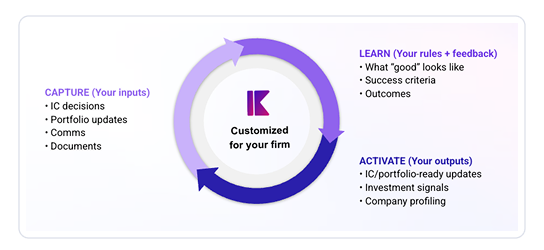
Kruncher is built from the feedback of more than five hundred private equity and venture capital professionals using the platform in their daily work. Rather than giving teams another blank AI interface, it organizes AI around the way a fund already operates.
One
Start with proven templates
Ready-made templates for origination, screening, outreach, meeting preparation, diligence, IC, monitoring, and reporting. A team that starts from a working template on day one is doing real work in week one. A team that starts from a blank canvas is still designing its process in month three, which is where most AI pilots quietly die.
Two
Configure them to your fund
Adapt investment stages, analysis criteria, terminology, responsibilities, approvals, and outputs to match your existing process. The templates are a starting point rather than a straitjacket, but they mean the configuration conversation is about your differences from a working baseline rather than about first principles.
Three
Standardize the work, not the judgment
Create a consistent starting point for research, analysis, and outreach across the team, with the same sections and the same sourced depth on every company, while keeping investment decisions firmly with your professionals. Standardizing the input is what makes comparison possible; standardizing the conclusion would be worthless and nobody would accept it.
16Sequencing
The first ninety days
Enthusiasm peaks at signature and decays from there. The engagement is structured to convert that peak into a habit before it fades.
Days 0 to 30
Foundation
Working sessions to capture the thesis, the universe in scope, and the existing workflow. The platform is configured to reflect it: scoring weights, signal categories, dashboards, memo templates, CRM and document integrations. Your isolated tenant is provisioned in week one.
Days 31 to 60
Adoption
The team uses the platform on real deals and real portfolio reviews rather than sandbox data. We coach through the first analyses, refine the configuration, and build the second use case on top of the first.
Days 61 to 90
Compounding
A value review with your leadership against the success criteria agreed at signature: what was promised, what has been delivered, what needs to change. Configuration is hardened and the team is operating independently.
Beyond day 90
Steady state
A dedicated account manager runs monthly checkpoints on usage, configuration drift, evolving thesis, and expansion, with formal value reviews at month three, month nine, and renewal.
In a larger firm, start narrow on purpose. A successful first deployment does not begin with rolling this out across the firm. It begins with proving value inside one or two teams and letting success drive expansion, with an internal sponsor, a specific universe to monitor, and a focused configuration covering one or two use cases rather than the full platform.
Part Four
The case
Arithmetic any fund can check against its own timesheets, what firms running on the layer report, and a pilot small enough to approve without a committee.
17Economics
The economics, quantified
Keeping a meaningful view of one private company current, which means checking for news, funding events, team changes, and product moves, and updating internal records, takes at least two hours per analyst per month.
Universe
Manual coverage cost
Practical consequence
100 companies
200 analyst hours / month
More than one FTE doing nothing but check-ins
1,000 companies
2,000 analyst hours / month
Roughly 12 FTEs. No firm staffs this, so coverage silently narrows instead
Same universe, resolved layer
Automated, continuous
Analyst review only where a signal fired; hours shift from checking to deciding
Origination task
Manual
On the layer
Initial screening
4 h / company
~1 h
Data points behind the decision
~20
~1,000
Deals reviewed
~200 / month
Not capacity-constrained
Tracking company changes
3 h / quarter each
Automated
Monitoring the watchlist
5 days / month
Automated, alert-driven
This is not an argument for replacing analysts. It removes the sixty to seventy percent of an analyst’s time that goes into research assembly, so the same team covers more surface area and spends its judgment where judgment is actually required, on founder relationships, thesis refinement, and the call itself.
18Evidence
Evidence from the field
Forty-plus paying firms across three continents, more than a hundred thousand companies analysed. What those firms report, in their own words.
“An analyst would take two months to onboard and a full day to do half of what Kruncher delivers in 15 minutes on day one.”
Scott Krivokopich
Founding Managing Partner, 1982 Ventures
“90% of our inbound was noise. Thanks to Kruncher, now we instantly know which deals deserve our attention and why.”
“Five hours of analyst work compressed into five minutes, without sacrificing quality. The depth of analysis actually improved.”
Oscar Marquina
General Partner, Marvin VC
“Our decisions were already strong; with Kruncher they are more structured, efficient, and transparent.”
Thomas Landis
Managing Director, QAI Ventures
A US mid-market PE fund with 130 portfolio companies reduced quarterly reporting from two weeks to one day after moving portfolio monitoring onto the layer. A mid-market PE firm running buy-and-build in facilities services screened 140-plus targets and closed two bolt-ons. A Singapore multi-family office runs daily operations, covering deal filtering, diligence, and LP reporting, on it.
19Next step
A scoped pilot you can approve
One of: a sourcing universe for origination, one portfolio for monitoring, or one data room for secondary pricing. In each case roughly 100 to 500 companies, running inside a dedicated tenant from day one.
Pilot metric
Measured as
Hours saved
Analyst time on monitoring and first-look research, against your recorded baseline
Coverage increase
Companies under continuous coverage versus under manual coverage before
Extraction accuracy
Sampled facts checked against source documents, by document type, on your own material
Stale-record reduction
Age distribution of key fields before and after, in the CRM or the record store
Material changes detected
Signals your team confirms as material, and detection lag versus your prior process
Auditability
Sampled output claims traced to source, page, and date without manual archaeology
20Close
Bottom line
Everybody rents the same model. What separates two funds looking at the same company from here is the knowledge layer underneath: unstructured data turned structured, entities resolved, facts dated and reconciled under explicit rules, everything standardized, and the firm's own judgment encoded on top.
And the layer alone is not sufficient. It needs an adoption framework that gives the team a working starting point, adapts it to how the firm already operates, and standardizes the work without touching the judgment. Otherwise you own good infrastructure that nobody uses.
One session on your own pipeline
Which of the five layers you already have, which are missing, and what it takes to close the gap.
Sections 03 to 20 are the build itself: the five layers in the order they have to be built, the 14-step ingestion pipeline, the opinionated data model, what to buy versus what to build, and the adoption framework that gets your engineering and investment teams there together. Your details unlock them on this page and start the PDF download.